Go to content

Guide to Visiting the De Hoop Reserve in South Africa, White Dunes and Fauna
The Hoop Nature Reserve is one of those places that not many tourists include in their South Africa itinerary on their own, but that we recommend you visit. There white dunes await you on a beach where whales approach between June and November, endemic flora and lots of fauna, especially antelopes and ostriches.
In this article we tell you how to get to and get around the Hoop Nature Reserve so that you can include it in your days in the Garden Route, it even has some very cool accommodations inside.
What is De Hoop Nature Reserve
De Hoop Nature reserve is a 4.000 hectare protected area, located just three hours from Cape with such biodiversity that it has been declared World Heritage by UNESCO. De Hoop has the largest preserved area of fynbos (a type of shrubs that create a blanket of flowers), 86 species of mammals, including the almost extinct bontebok and is also home to more than 260 species of birds.
But in addition, the reserve not only on land and the coastline, but also extends three nautical miles towards the sea, protecting dolphins, seals, southern right whales and at least 250 species of fish. Come on, you couldn't ask for more diversity, it's a wonderful place. Add to all this that not many people visit it and that the roads are unpaved. Impossible not to fall in love with De Hoop.
Although it is not officially part of the Garden Route, many of us add it to the route we take between Port Elisabeth and Cape Town, we went after spending the night near Mossel Bay and before reaching the southernmost tip of the continent in Cape of the needles. You can read about all of these sites in the 12 Best Places to see on the Garden Route.


How to get to De Hoop Nature Reserve
Access to De Hoop is not as prepared as other Parks in South Africa, part of its charm! But it is something to keep in mind, because te tocarto cover quite a few kilometers of track, generally in good condition but with the occasional hole and being quite a few kilometers long it can become tortuous.
There are two main entrances: One by Spitskop, where you will go if you come from Cape Town by N2 or from Cape Agulhas and another by Malagasy, which is closest to Mossel Bay. Both have more than 50km of track. But in the case of Malagas in worse condition, or so it seemed to us. In addition, you have to cross a small river with a free ferry (Malagas Pont – Ferry – free crossing).
We entered de Hoop through Malagasy and we went out Spitskop. And the Malagas track was much harder for us, even though crossing the river was fun. There were too many kilometers without asphalt and raising dust as we passed through pWild West desert landscapes and ostrich farms in the distance.
You can trust Google Maps which works well in South Africa, but keep in mind that with the car"Unpaved roads" is overly optimistic. Despite going at the speed limit, or even a little faster, it took us almost 45 minutes longer than what we were told.
How visit the De Hoop Nature Reserve
To tour De Hoop Nature Reserve, and reach the best places in the reserve you will need a rental car, I really like to visit almost any place in South Africa. But once there, and unlike most African parks, you have the option of hiking or renting a bicycle (an experience that we lived in Esuatini).
In this case we are limited to visiting De Hoop by car and spending the night at its campsite, which also has bungalows, then we will give you more information.
Just like day-visitor access to De Hoop is from 08:00 to 16:00After that you cannot leave the premises, well yes you can, but you will probably get a fine. If you stay the night inside you can circulate until after sunset.

CHow much does it cost to enter De Hoop?
The conservation fee is included in the Wild CardIf you don't have it, the price is 50 Rand per person (€2,50). Whether you have it or not, it is accessed through the checkpoint where you will have to register.
Accommodation within the De Hoop Reserve
Within the Reserve there are several accommodation options, which allows you to stay until after 16:00 p.m., and best of all, sleep in a spectacular environment.
The best option is De Hoop Collection, they have some cabins with shared bathrooms in the camping area and others suites more luxurious (and caras). You also have the option of staying in a tent or campervan at the campsite, that's what we did and it cost us 245Rands per couple (€12,50).
What we did take advantage of was the hotel restaurant, Fig Tree Restaurant. You can go without being hosted, The prices are good and the environment with views of the river is wonderful. We treated ourselves to a buffet breakfast for €7 per person.


Do you want to travel to South Africa cheap? Read our experience at tent. And so as not to forget, nothing points well everything you need to bring to South Africa.
Things to do in De Hoop Nature Reserve
Koppie Alleen, Dunas Blancas beach and trails
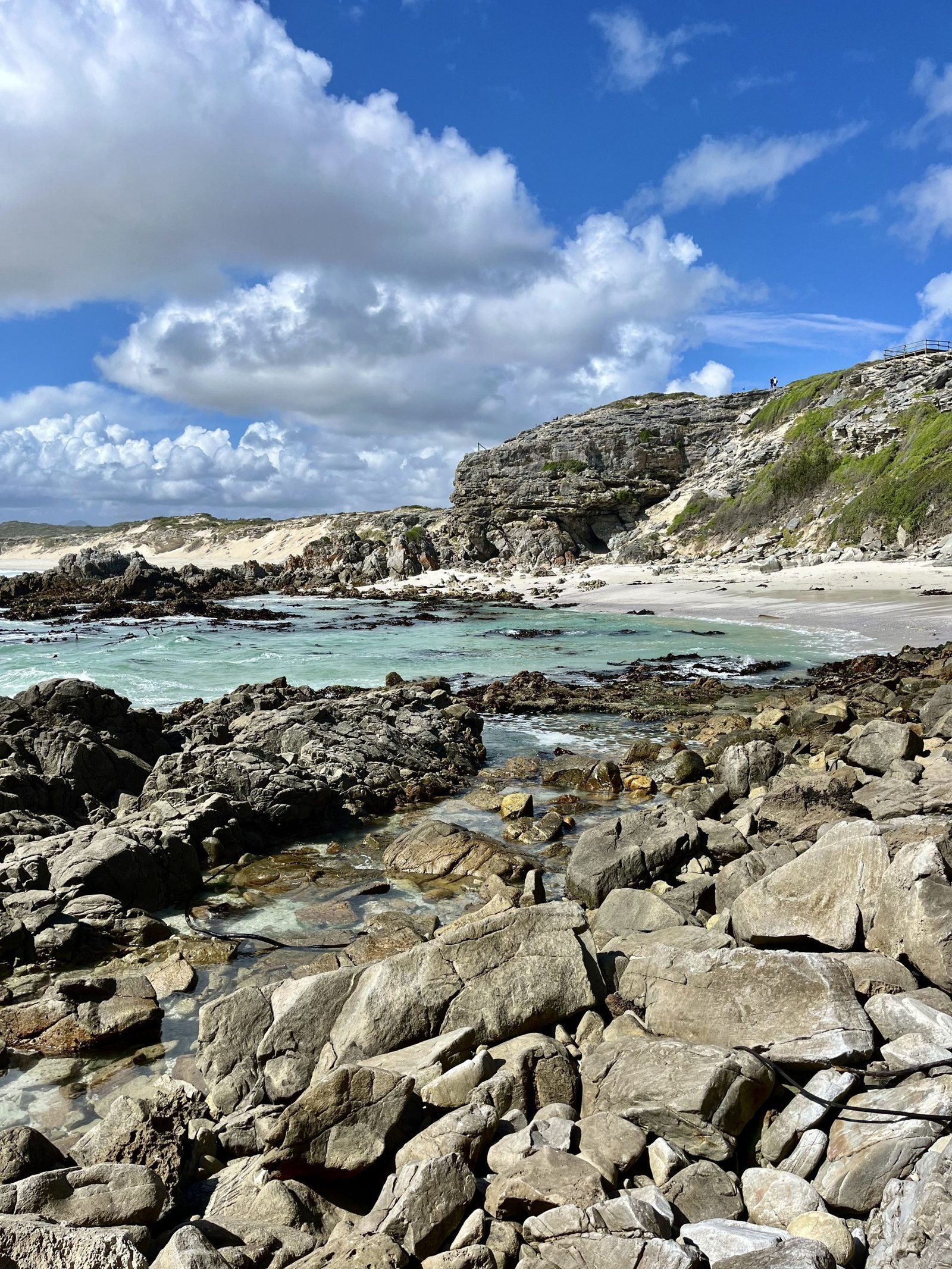
The greatest attraction of the reserve is Koppie Alleen, the beautiful and iconic dune landscape that has been created on the beach. Furthermore, to get to it you have to take a small path of white sand surrounded by native flora of the region, at least when we went it was beautiful. Getting to and visiting this place will take you at least three hours.

Once in the dunes you can walk around the area, either going up some to better see the immensity of the landscape or going down to the water. At low tide several tidal pool where to take a dip or simply docarsLook how beautiful they are.
During the months of June to November you can sit on a dune and try to spot southern whales, so don't leave your binoculars in the car. Or you can also do it from the Bites Beach Café, it seems to be a very cute place, but when we went in February it was closed.

De Hoop Safari Drive
Of course, there is no shortage of paths where you can go slowly and pay attention to see what animals cross your path. In the De Hoop Reserve, antelopes stand out, we were able to see many types and very close. The most emblematic is the bontebok, an antelope endemic to South Africa that was on the brink of extinction. and De Hoop has done an incredible job bringing it back.
Also inhabiting the reserve are many Cape Mountain Zebra, elands, and gray rhebok, which share habitat with hundreds of ostriches, jackals, baboons, and yellow mongooses.
Birds are not far behind, there are 260 species. Our favorite the secretary bird, a very large bird of prey that hunts snakes and other reptiles, trampling them with its legs. Since we discovered it in the book of Kruger We were eager to see it and finally in De Hoop we were able to spend a good time observing two.


Hiking and Biking
As I mentioned before, there is areas enabled for hiking and mountain bike routes (you can rent it there). We leave you the official website to see it, and you can also ask at the access control or at the reception of the De Hoop Collection.

We didn't do any of them, but there was no need because around the campsite we saw antelopes and ostriches, and even a few turkeys decided to sleep next to our tents.
Reserve Map
We leave you the official map of the Reserve so you can find your way, it was the one they gave us when we entered along with some information on the back about what animals can be seen and conservation tasks.

More places to visit in the Garden Route
The garden route is one of the road trips most epic things you can do in South Africa, with many worthwhile stops. We leave you articles with a lot of information about what to see on the Garden Route.
- Complete Guide on the Garden Route (or Garden Route)
- How to Visit Addo Elephant National Park
- What to see and do in the Tsitsikamma National Park
- View sea lions in Robberg Nature Reserve
And of course, visit the Cape Peninsula in 1 day Although it is not part of the Garden Route, it is one of the best things you can do in Cape Town.

I hope I've helped you plan.car your visit to De Hoop Nature Reserve or having convinced you to visit it in your South Africa itinerary. To continue organizing your trip you can read our articles to travel to south africa and Guide to traveling to South Africa.
Thanks for reading us! And you can leave any questions or contributions in the comments.
Did you know….
By purchasing through our links you are supporting us at no extra cost to you. Thank you for helping us grow ♥